
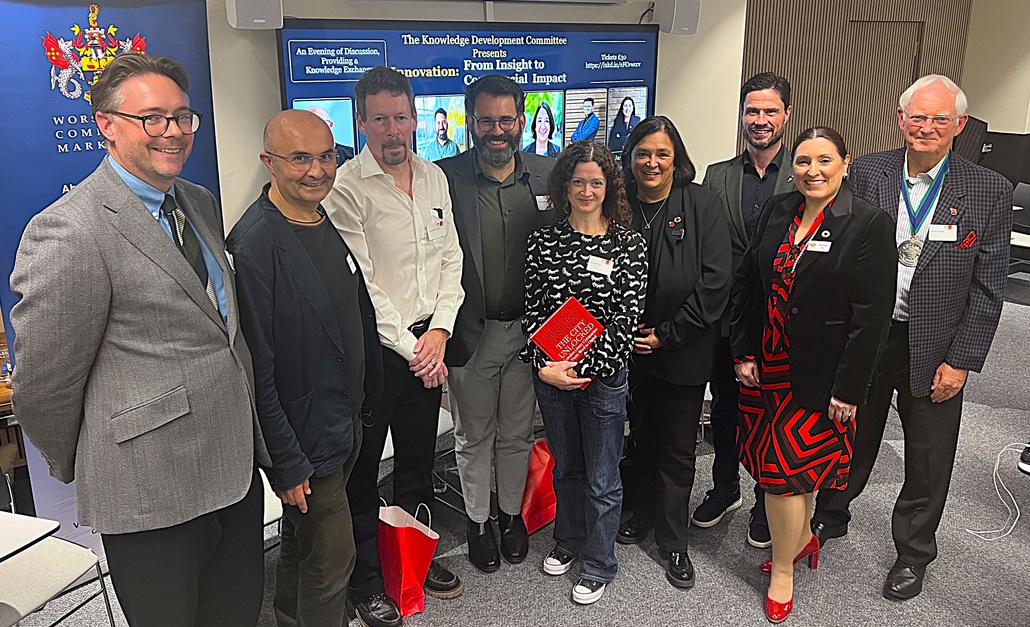
The Master and speakers at the Innovation From Insight to Commercial Impact Event
Written By Professor Stan Maklan
On the 29th October 2026, the Knowledge Development Committee of the Worshipful Company of Marketors held an open event entitled Innovation From Insight to Commercial Impact. The event was sponsored by Sabio Inc and hosted by Royal Holloway University of London at Senate House London.
This was the second in the series of four Knowledge Exchange events. The format was a series of open-ended questions for panel response with audience involvement.
The event was a panel discussion comprising:
· Omaid Hiwaizi, Founder and Fractional CMO, and Deputy Chair of the KDC
· Alex Merrifield, Chief Product Officer, Work Buzz
· Guillermo Dvorak, Director of Sales EMEA, Sabio Inc
· Jen Wright, CEO, Rascal Ventures
· Professor Lucy Gill-Simen, Associate Dean, Faculty Business and Law, Royal Holloway University of London
· Paul Skinner, Author of The Purpose Upgrade & Collaborative Advantage, Founder of MarketingKind & The Agency of the Future
· Jarmila Yu, Founder and Consulting Chief Marketing Officer & Growth Mentor, YUnique Marketing Ltd, and Chair of the KDC
First, the panel was asked to define innovation. The answers were short definitions, a perspective on the beneficiaries of innovation, and the mindset required to achieve it. The definition of innovation was “better” (Alex) or a “story of better” (Paul). Interestingly, all panel members volunteered that, to succeed, innovation needs to be managed for the benefit of others rather than the firm alone. So “better” for whom? Lucy focused on creating new opportunities for [human] flourishing, whilst Alex focuses on creating more value for customers, stakeholders, communities and nations. Such holistic approaches to “better” require that education includes a humanist perspective (Lucy) that promotes curiosity, wonder and the ability to ask “what if” (Guillermo) . Coupled with asking questions is a willingness to break rules when driving change through an organisation (Jen). All agreed that constant contact with customers is essential for imagining what “better” is for them.
Omaid then asked the panel to explore the gap between merely adopting new technology versus genuine business transformation. The panel’s response focused on what I would call the fuel (data) and the fire (change). The context of new technology elicited the panel’s interest in the data available to the profession (Guillermo) and marketers’ ability, or lack thereof, to move from data to insight to new offers (Paul). Paul defined insight as actionable new data or perspective, not merely new information. The implication is that commercial impact results from translating actionable insights into a changed offer.
The third area of discussion introduced AI (of course) and how it relates to human agency, in the context of innovation. The panel’s comments coalesced around how humans direct AI towards exploration and flipping traditional theories of competitive marketing strategy when using AI. Lucy provided an example from her own teaching wherein students first use pen and paper to create a mind map-like artefact of how to think about a new opportunity and then use AI to generate questions and research across each “branch” of the map, thus informing students’ critical reflection by recursively creating new lines of enquiry. Over time, the interaction of students’ critical thought with AI support makes for far richer analysis, building curiosity, courage and imagination; all contrary to widely held critiques of AI’s impact on learning.
Paul, Alex and Jen used different terms to pursue a critique of widely practised competitive marketing theory. Paul talked about evidence that purpose-led innovation outperforms profit-maximising innovation. That is, innovating to create better outcomes for customers and stakeholders is associated with greater impact for both the firm and its stakeholders. Similarly, he suggests that traditional thinking about investing behind your competitive advantage might miss what customers really want. Instead, he proposes “collaborative advantage” as a complementary or even alternate framing to competitive advantage wherein innovation is driven by customer-relevant outcomes rather than what the firm may be particularly good at doing.
In a similar vein, Alex commented on the traditional tension between exploration and exploitation. Implicit in his contribution was that exploitation provides a linear and obvious path to commercial outcomes, which makes it easier to secure support within organisations. However, exploration is needed to keep the organisation fresh; without it tends to wither, and its purpose or mission fades and its strategy drifts. Exploration does not occur linearly, and this makes it more difficult to secure organisational support.
Jen flipped the traditional marketing strategy of a “target of one” to “an opportunity for one.” Echoing the above comments, she argued that targeting suggests more of an exploitation of opportunity mindset, whereas “opportunity for one” suggests engaging individually with customers to maximise the value you can create for them. AI is relevant in this context as an enabler of that fine-grained development at scale.
Finally, the conversation moved towards leadership, and the panel coalesced around Jen’s articulation of how leaders support others to learn, to be curious, and even to fail. Leaders should be curious about their people and what motivates them to innovate. A culture of being right all the time and an excessive focus on optimisation and metrics does not promote human-inspired innovation.
In the subsequent Q&A, the panel was asked about the role of the humanities in education and the value of being a first mover in innovation. The panel acknowledged that many firms, including ones they worked for/with, were fast followers and were “innovative” in how they discerned which innovations to emulate and improve upon. Jen cautioned that fast-following may be fine, but one needs to define and focus on the value created first and foremost. Paul, however, suggested there is a difference between value-creating innovation and value concentration implying a following strategy might favour the latter.
Omaid then asked the panel for a one-sentence answer to: what is the biggest trend you see in the immediate future? Alex was first off and respected the one-sentence rule by saying simply: faster, faster. Guillermo felt that devices, particularly the TV, will feature more prominently in helping consumers buy more effectively, enabled by the collection and analysis of data at a fine-grained level. Jen suggested everyone will, or perhaps should, have only one title: that of innovator. For her, there is only one question to ask of people at work: what are you solving? Lucy focused on the ability of humans to make better choices, and Paul suggested that above all, we need to organise ourselves to use what we invent rather than just be anxious over it.
The focus of the evening was on how we can promote agency and an other-centred perspective (customers, stakeholders) to lead innovation with high impact, high value created. Perhaps an interesting follow-up event might build on these valuable insights and focus on how we scale such breakthrough innovations to capture some of that value for our organisations and country.
I would summarise the key themes running through the event as:
1. Innovation is about creating value for others (customers) and not merely creating new stuff.
2. AI should enable, not replace human agency: our curiosity, critical thinking, and willingness to challenge orthodoxy are vital components in creating impactful innovation.
3. Organisations need to move beyond immediate optimisation to promote a humanistic-centric innovation culture.
This was the second event in the series and once again attracted a packed room of 50 participants. Planning is now underway for an event in Q1 and in Q2 2027. Please visit the Marketors LinkedIn page for details on when the next events will be taking place.
About the Author
Stan is a Freeman of the Worshipful Company of Marketors and Emeritus Professor Cranfield School of Management, where previously he was Director of the Cranfield Centre for Strategic Marketing and Sales. His writing and teaching foci were Big Data - Marketing Analytics, Customer Relationship Management (CRM), Customer Experience (CX), Marketing Measurement and Accountability and Marketing Leadership. He has co-authored several books, most notably a global best-selling textbook on Customer Relationship Marketing, now in its fifth edition.
Stan began his career with Unilever Canada, subsequently moving with that firm to the UK and Sweden, where he was Marketing Director of its Toiletries business. He then spent ten years as a management consultant, mostly with international IT companies.
He was awarded honours for academic excellence in the MBA from the University of Western Ontario - now Ivey School of Management and has a Bachelor of Science in Economics from the Université de Montréal. He has a PhD from Cranfield University.
This event forms part of a series of Knowledge Exchange Events that the Knowledge Development Committee are building. Please look out for future events so you can be in the room and part of the dialogue. Events will be promoted on the Marketor Website and LinkedIn page.