
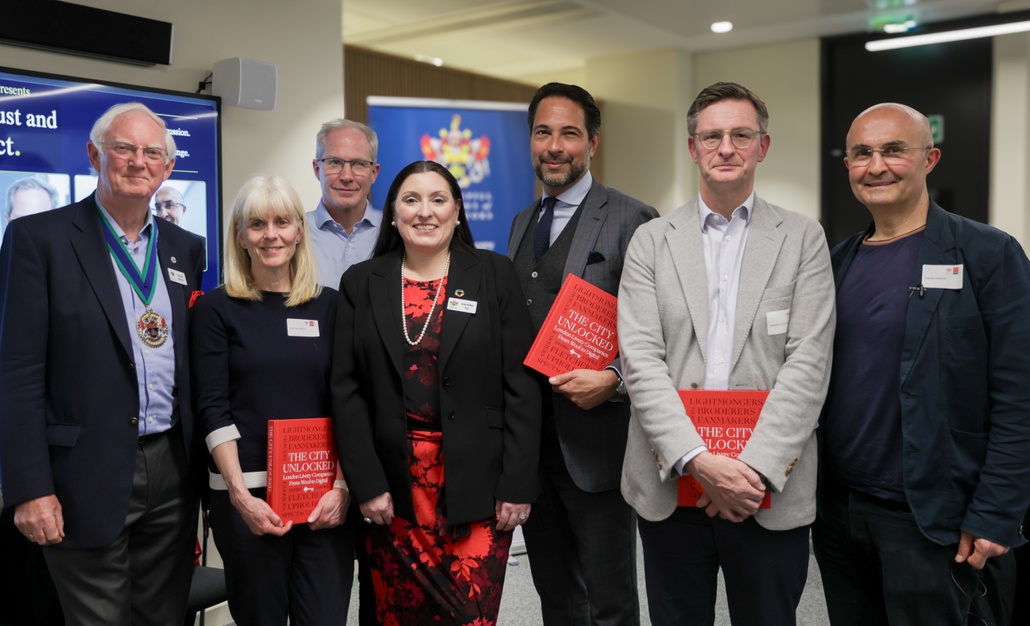
The Master and speakers at the Brand Strategy, Trust and Commercial Impact Event
Written By Professor Stan Maklan
On the 14 May 2026, the Knowledge Development Committee of the Worshipful Company of Marketors held an open event entitled Brand Strategy, Trust and Commercial Impact. The event was sponsored by Sabio Inc, hosted by Royal Holloway University of London at Senate House London and supported by the Data & Marketing Association.
The event was a panel discussion comprising:
- Jarmila Yu, Founder and Consulting Chief Marketing Officer & Growth Mentor, YUnique Marketing Ltd.
- Christian Gladwell, Senior Director Strategy and Partnerships at Sabio Inc
- Dr Darren Coleman, Founder The British Institute of Branding and Author of Building Brand Experiences
- John Jeffcock, Chief Executive of Winmark and Author of the Suite Spot
- Kate Burnett, General Manager, People and Talent at The Data Marketing Association (DMA)
- Omaid Hiwaizi, Founder and Fractional CMO
The format was a series of open-ended questions for panel response with audience involvement. With the expertise of the panel and the deep experience of the audience, Jarmila managed to ask only a handful of questions as the conversation was so animated and the audience relished the brief to engage in a fireside chat manner with one another. For those of you that missed out on attending the event I will try to summarise the themes and points of view covered to catch you up.
Two main themes emerged from the panel:
1. The brand is an intangible asset with unique properties not fully acknowledged across the C-suite. This asset is necessary, but not sufficient, for the development and profitable execution of the strategy.
2. A dichotomy of thinking about the impact of AI; it fundamentally changes the way consumers make decisions, or people will still process information through stable cognitive processes that are not really affected by AI
Much of the conversation focused on different aspects of what is familiar to marketers: the brand is an asset that generates wealth over time by engendering customer loyalty, offering potential for premium pricing, holding power within the distribution channel, and serving as a platform for successful innovation.
Many on the panel discussed a unique aspect of the brand-as-asset; namely, brands might be the legal property of the owner, but they are intangible assets, essentially co-created with customers.
Christian Gladwell delivered a most memorable comment of the evening: " You have to exist in the mind before you can exist in the market.” This underscores a widely held view that commercial success relies on strong brands built with consistency over time that clearly define the concept.
This “in the mind” idea was widely discussed. Most panel members identified the duality between “thinking” and “feeling”. The panel discussed the example of a financial services brand that had built widespread brand name awareness, but people did not know that the brand sold. Some said this is evidence of poor marketing, whilst others believed a base had been built for the next stage of brand-building. However, most of the discussion focused on feelings rather than brand awareness and saliency. Darren suggested that people don’t spend a lot of time thinking about your brand, you need to make people feel more than think. He stated: "Brands don’t become valuable because they’re understood. They become valuable because they’re felt.”
The notion of feeling generated a long discussion about positioning brands as a concept more than an association with a specific product or service. Again, Darren offered that connecting a brand with a concept, based upon feelings, allows the brand to move into other business areas and increase the value generated by the brand. Christian offered the example of Bulgari extending from jewellery to hotels, Virgin from airlines to many things, whilst a member of the Company related her experiences at John Lewis and its assessment of the breadth of brand extension opportunities. There was a lively discussion of brand extensions, with many members of the audience being able to identify successful and unsuccessful attempts. The success of brand extendibility tends to revolve around the identification of leverageable brand attributes that are relevant to the targeted new market.
There were numerous miscellaneous observations around these themes. Brand governance, the ownership structure of the firm, and the appreciation of the C-suite about the nature of brands were all identified as barriers/enablers of brand development. John shared that Brands, and the value of brands, are not discussed as much as they should be in the boardroom. The link between brands and business development was identified as bridging the gap between brand advocacy and top management team support. Trust (Kate Burnet) and authenticity (Jarmila) were identified as vital antecedents to brands affecting strategy and commercial success.
The discussion moved into AI, it is inevitable! There seemed to be two schools of thought around the impact of the AI revolution upon brands.
Some believe that AI is fundamentally changing the way people make decisions and, therefore, affects the role of the brand. The discussion implied that AI weakens the role of brands in consumer decision-making. If brand value lies in the concepts, the emotional meanings attached to the brand, such as “Kodak moments”, AI agents look at claimed performance, reviews, price and claimed user preferences. They generate recommendations differently from how brand owners wish to present their offers. The emotional and symbolic dimensions of branding risk being neutralised by algorithmic selection processes.
However, the majority of the panel took the view that AI is more of a decision-support tool rather than a transformation of consumer behaviour. Consumers retain agency and will continue to interpret information through existing cognitive and emotional processes. They will make human judgments about trust, identity and value. AI may make evaluation more efficient and comprehensive, but it does not eliminate the fundamentally human nature of consumption and brand choice.
Omaid felt that whilst LLMs improve consumer decision-making rather than replace it, he observes in practice that SEO marketing is transforming towards influencing the LLM. He notes that startups that lack the deep online repository of comments, reviews and analysis are at a disadvantage in this regard, as agents will favour the brands with a deeper presence. He also challenged the panel by suggesting that consumers are not passive content recipients but active creators, and this is a fundamental communications challenge to brand owners. So how transformational AI is upon the brand remained contested territory.
Three actions for CMOs:
1. Link discussions about brand development to innovation and business development. This potentially bridges brand building with the firm’s strategic direction and commercial success.
2. Test the extent to which AI agents shield the emotional content of your brand from consumers and take appropriate action.
3. Determine the optimal balance between what people think about your brand and how they feel about it.
Three actions for Business Leaders:
1. Avoid the often quoted “AI changes everything” sentiment until proven more robustly. There remains a strong intuitive argument that human behaviour, including customer decision-making processes, is more stable than technology developments.
2. Engendering a powerful emotional connection between your customers and brand(s) may be even more important as customers use AI to improve their purchasing processes.
3. These emotional connections move beyond the competitive qualities of your offers to include customers’ judgements about your trustworthiness and values.
Conclusion
Faced with extraordinary events and technology, marketers are somewhat conflicted between “AI changes everything”, and the famous French expression “plus ça change, plus c'est la même chose." As a profession, we should not be complacent, thinking that our core thinking about the role of brands in business remains unchanged, but I am equally convinced that the AI we see today will not replace human agency in our decision-making. The unique nature of brands, an asset co-created with customers (and other stakeholders), remains both commercially powerful and yet amorphous. This has always been the case, and the panel highlighted the intangible nature of brands’ value to the business and its role in creating an emotional bond with customers. Had the discussion carried on, I think we would have concluded that we must continue building that bond with customers, but recognise that there are important new challenges and ways of making that happen.
About the Author
Stan is a Freeman of the Worshipful Company of Marketors and Emeritus Professor Cranfield School of Management, where previously he was Director of the Cranfield Centre for Strategic Marketing and Sales. His writing and teaching foci were Big Data - Marketing Analytics, Customer Relationship Management (CRM), Customer Experience (CX), Marketing Measurement and Accountability and Marketing Leadership. He has co-authored several books, most notably a global best-selling textbook on Customer Relationship Marketing, now in its fifth edition.
Stan began his career with Unilever Canada, subsequently moving with that firm to the UK and Sweden, where he was Marketing Director of its Toiletries business. He then spent ten years as a management consultant, mostly with international IT companies.
He was awarded honours for academic excellence in the MBA from the University of Western Ontario - now Ivey School of Management and has a Bachelor of Science in Economics from the Université de Montréal. He has a PhD from Cranfield University.
This event forms part of a series of Knowledge Exchange Events that the Knowledge Development Committee are building. Please look out for future events so you can be in the room and part of the dialogue. Events will be promoted on the Marketor Website and LinkedIn page.